Why Your USAJOBS Applications Go Nowhere: The "Referred" Wall Explained
Emily A. Hall ·
Why Your USAJOBS Applications Go Nowhere: The "Referred" Wall Explained
Most people who give up on federal hiring give up at the same spot. They apply to twenty or thirty announcements, get twenty or thirty automated emails that say "Not Referred," and decide the system is rigged or broken. It isn't rigged. But it is different from any hiring process in the private sector, and nobody explains the rules before you play.
So let's explain them.
What actually happens after you hit submit
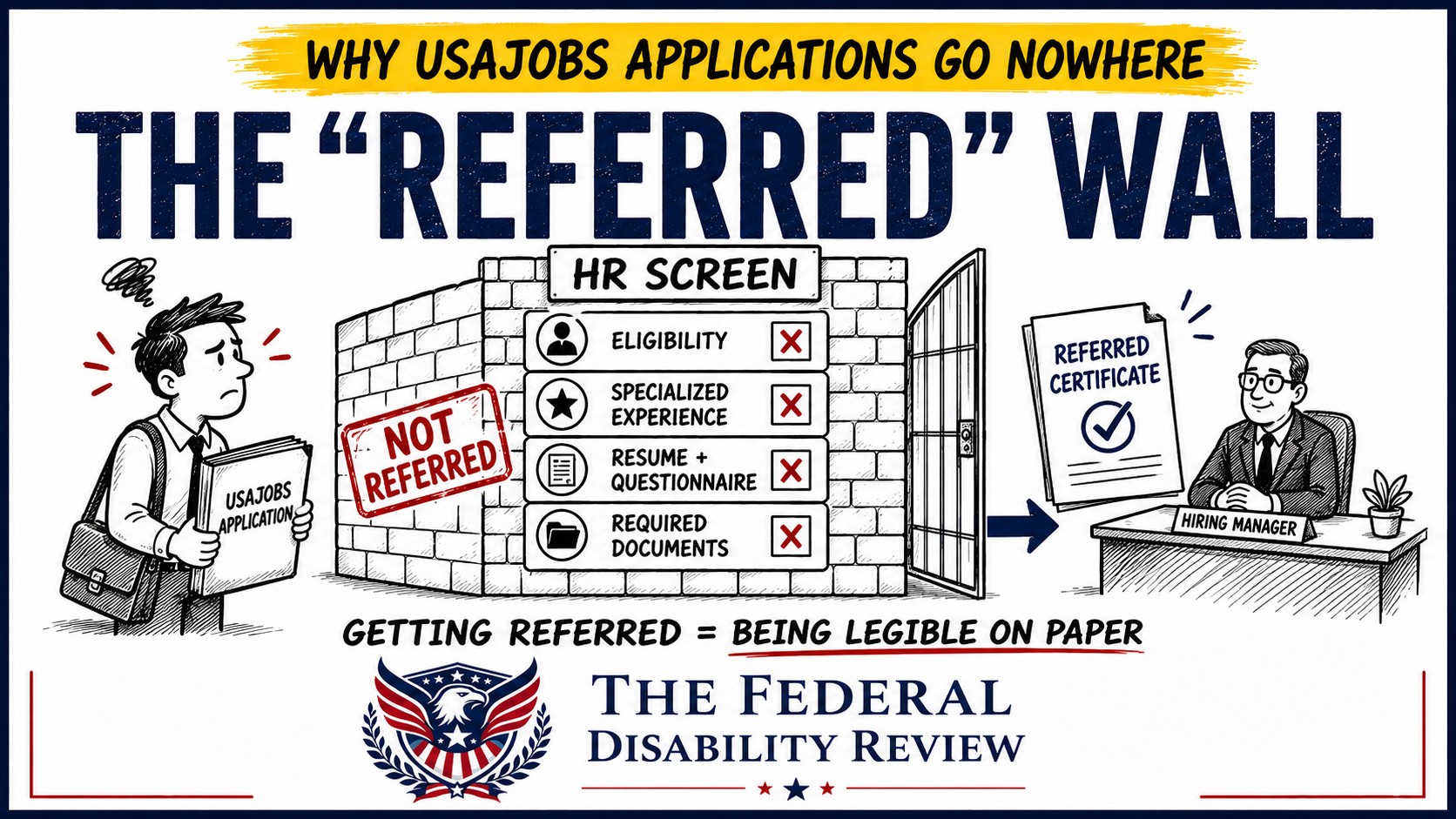
Your application doesn't go to the hiring manager. It goes to a human resources specialist whose job is to screen every application against the announcement — not against the job as you imagine it, but against the written announcement, line by line.
That specialist is answering a few questions in a specific order. Do you meet the basic eligibility for this announcement? Do you meet the minimum qualifications, including the specialized experience it describes? Does your resume back up the answers you gave on the questionnaire? Did you attach every required document?
If you clear all of that, your name goes on a list called a certificate, and that certificate goes to the hiring manager. That's what "Referred" means. Your application finally got to a person who can interview you.
"Not Referred" means you fell somewhere before that point. And here's the part that stings: it usually has nothing to do with whether you could do the job.
The resume has to prove the questionnaire
Almost every announcement includes a self-assessment questionnaire, and it asks you to rate yourself on the duties of the job. Most people answer honestly and modestly. Then the HR specialist compares those answers to the resume — and if you rated yourself an expert at something your resume never mentions, your rating gets knocked down or your application gets set aside.
This is the single most common reason capable people get screened out. The questionnaire and the resume are one document in HR's eyes, and they have to tell the same story. In a case I saw during my time at the FAA, a well-qualified analyst was screened out of a job she was already doing pieces of, because her resume described her position title and not her actual duties. The specialist can only credit what's on the page.
"Specialized experience" is a phrase, not a vibe
Every announcement defines the specialized experience required, usually one dense paragraph. That paragraph is the test. The specialist is looking for evidence in your resume that you have done those specific things, usually for at least a year at a comparable level.
A private-sector resume summarizes. A federal resume has to demonstrate. If the announcement says the job requires "experience analyzing program data and preparing reports for management," your resume needs to show you analyzing program data and preparing reports for management — in those kinds of words, tied to a real job with dates and hours.
The quiet killers
A few things end applications before anyone reads a word of your experience. Missing documents are the big one — transcripts when the announcement requires them, your DD-214 if you're claiming veterans' preference, an SF-15 and VA letter for 10-point preference, a Schedule A letter if you're applying under that authority. There is no "we'll follow up with you." Incomplete packages get set aside.
The other quiet killer is applying to announcements you were never eligible for. Some announcements are open only to current federal employees or other special groups. If you're a member of the public applying to a merit-promotion announcement, you were out before you started, and the rejection email won't explain that.
What this means for you
Getting referred is not about being impressive. It's about being legible — writing an application a screening specialist can credit under rules she doesn't get to bend. That's a learnable skill, and it's a completely different skill from doing the job.
If you've been applying for months and hitting the same wall, the fix usually isn't more applications. It's one properly built federal resume, aligned to the announcements you actually qualify for, with your documents in order.
That's exactly what I do. If you want a second set of eyes on why your applications aren't landing, my resume review and federal resume writing services are built for this — you can find them on the Services page.
The Federal Disability Review, LLC is a non-attorney consulting practice and is not affiliated with the U.S. government, OPM, or any federal agency.